 The Food Safety App
The delivery record the pack asks for and does not print
Two safe method sheets in the pack tell you to check food as it is delivered. Neither comes with anywhere to write down what you found, because SFBB publishes no form for goods in. That gap is why most kitchens can describe their delivery checks and prove none of them.

Free to use. No ads, no paywalls.
The pack asks for this twice. The Prove It sheet says to test the surface temperature of cold food when it is delivered. The stock control sheet says to check all stock as it arrives. Both are instructions to find something out, and neither has a box to write it in.
So the delivery record is one of the parts of this app that is ours rather than the FSA’s. Worth being precise about why: the FSA’s separate Safe Catering pack does publish a delivery record, SC1, but SFBB has no form for goods in, and SFBB is the pack this app follows. See what goes in the inspection pack for which records print onto an FSA template and which get a plain page of ours.
What a delivery check is actually for
A cold chain is only as good as its weakest handover, and the handover you control least is the one at your own back door. A chilled load that spent forty minutes on a warm pavement is a problem you inherit, and the only moment you can refuse it is before it goes in your fridge.
The record is not paperwork for its own sake. It is the difference between "we always check deliveries" and being able to show the morning you did not accept one.
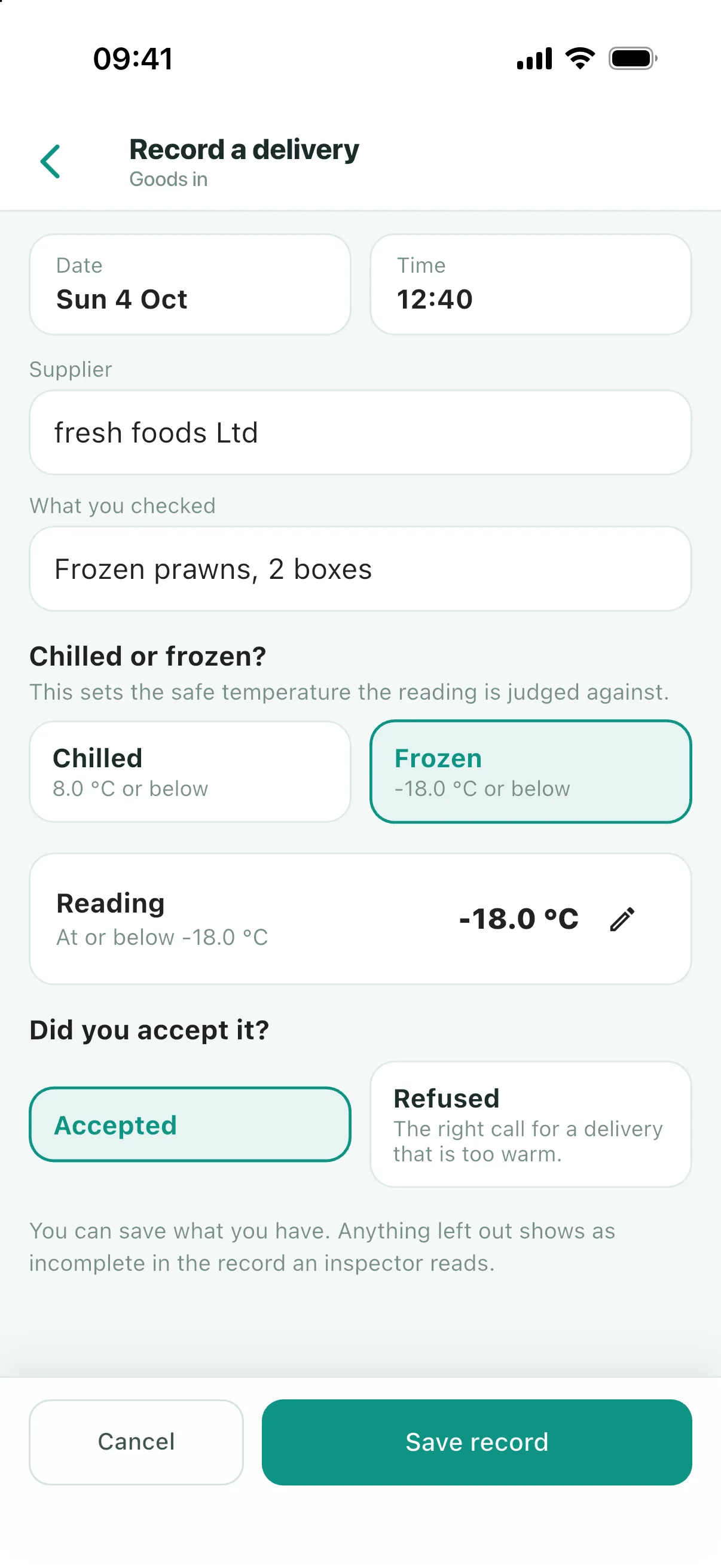
What one entry holds
- The date.
- The supplier.
- What was delivered.
- The temperature you read.
- Whether it was chilled or frozen.
- Whether you accepted it or turned it away.
Chilled and frozen are not the same check
The kind is picked before any reading exists, because it decides what a safe reading looks like:
| Kind | Safe at |
|---|---|
| Chilled | 8 °C or below |
| Frozen | -18 °C or below |
They are one Deliveries feature rather than two, because a mixed order is one delivery and no kitchen thinks of it as two. The safe band is not shared, though, and that is the detail worth getting right: a single band drawn across both would show a correct frozen reading of -18 °C as a failure, and a dial that cries wolf is a dial people stop reading.
Accepted or refused, as a value rather than a sentence
The outcome is a typed choice, not a note. The question an officer asks is never "what was the reading", it is "you found it warm, so what did you do about it", and the answer to that should not depend on how five different members of staff chose to phrase it.
Typed, the record can also be totalled: the pack can state that two deliveries were refused in the period. As free text it has to be read line by line and summarised by whoever is standing there.
It never guesses, either. An outcome the app cannot establish is left empty rather than filled in, because the only thing worse than a delivery with no outcome recorded is one recorded as accepted when the kitchen turned it away.
Questions
Is there an SFBB delivery form?
No. SFBB publishes a diary, the Prove It checks, the safe method sheets and the completion record among others, and nothing for goods in. The FSA’s separate Safe Catering pack does publish a delivery record, SC1, and the app prints a plain A4 table of its own rather than that form. It goes into the inspection pack alongside the official ones.
Do I need to record every delivery?
Your own food safety management system decides that, and your local authority has the final say on it. The pack’s instruction is to check stock as it arrives, so a record of the checks you do is the evidence that you do them.
What temperature should a chilled delivery be?
The app treats 8 °C or below as the safe band for chilled and -18 °C or below for frozen, which is what the pack works to. A reading outside it is not automatically a refusal: it is a decision, and the record keeps the decision.
Does it print in the kitchen’s language?
No, and that is deliberate. The whole pack prints in English whatever language the kitchen works in, because the person reading it is an environmental health officer. The app itself is translated; the export is for the officer.
Keep reading
Write down what you found at the door
Free on iOS and Android, and part of the one-tap inspection pack.